Category: GBC Modules

  • Lego GBC Batch Counter

    Lego GBC Batch Counter

    Lego GBC Batch Counter is a Lego Great Ball Contraption Module built for the Great Ball Pit – Challenge 2020, and is a module designed to output a batch of exactly 13 balls (or a range from 2-30) in a single batch.

    You can read more about the challange here https://www.greatballpit.com/2020/09/great-ball-pit-challenge-2020.html

    Program

    The program was written in Lego’s block language and has 3 main parts

    1. Button event capture, for capturing the inputs from buttons and changing the target count and motor speed variables
    2. Distance counter loop, for counting the number of balls passed.
    3. Motor control loop, for running the conveyor or tipping ramp.

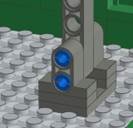
    I also setup a control panel with buttons and guages to see what was going on.

    Videos

    Video of this module in operation
  • Lego GBC Christmas Tree Topper (for the Brickworld Ball Pump)

    Lego GBC Christmas Tree Topper (for the Brickworld Ball Pump)

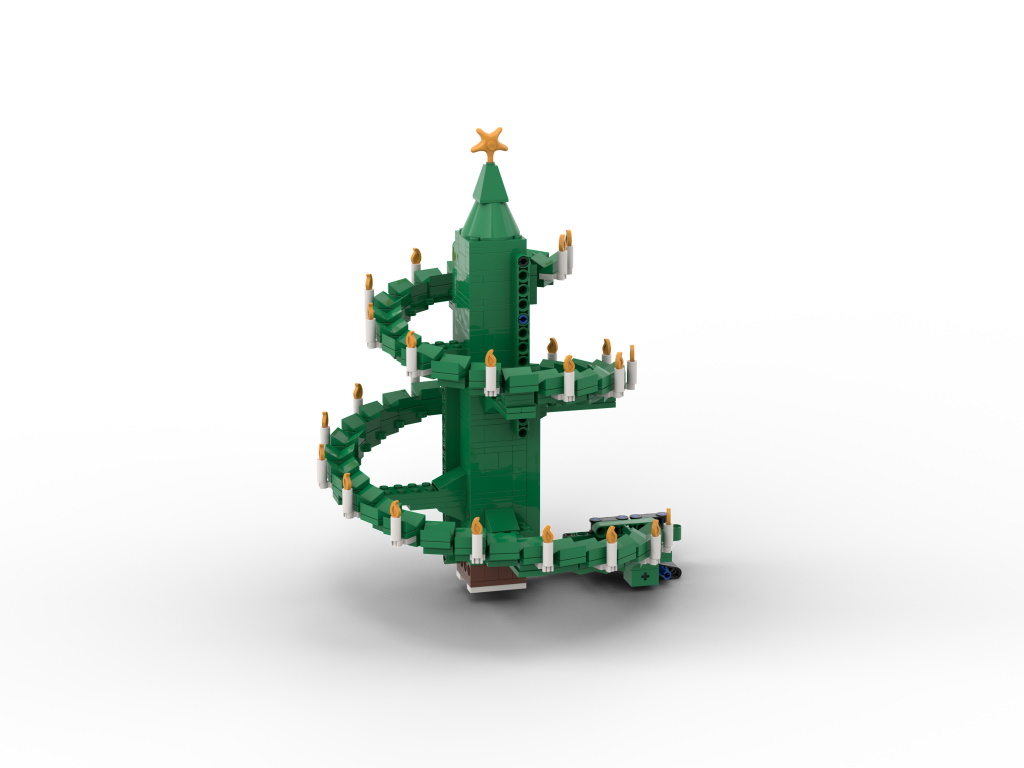
    Lego GBC Christmas Tree Topper (for the Brickworld Ball Pump) is a Christmas themed module designed by Lawrie George.

    By combining this adapter with a GBC Brickworld Ball Pump you get a Christmas tree-themed module, that can be used as a compliant GBC module or a Recirculating module,  and UV charging station that will saturate all balls that pass through it for 3 seconds.

    Night Lighting

    This topper is designed to have a UV LED strip like my Lego GBC Brickworld Ball Pump UV LED Adapter Instructions for charging balls.

    Videos

    Videos of these modules in operation

    Modules

    Builds and revisions to this module

    Original

    Pieces Cost Difficulty
    <250 $$ Easy

    The instructions can be found here: Lego GBC Christmas Tree Topper (for the Brickworld Ball Pump)

    • Initial design with star and angel options.

  • Lego GBC 9

    Lego GBC 9

    Lego GBC 9 is a steampunk themed module that carries the ball through a 9 shaped path on their way to the next module. It uses a continuous loop chain and pushes it to its limits by taking a Mobius strip style of path and given the strain on the chain I expect this to be a short lived module.

    Night Lighting

    For this module I used a string of UV Leds shining on the back of trans-neon panels, the ball path itself is not directly charged.

    Videos

    Video of this module in operation

  • Lego GBC Tower Crane (Bridge Module)

    Lego GBC Tower Crane (Bridge Module)

    Lego GBC Tower Crane (Bridge Module) is a Utility Module for bridging gaps in  Table Layouts and was designed by Lawrie George.

    The module stands over 80″/200cm tall (when on a table) and spans gaps of 36″/91cm, it is fully self-supporting and uses a 750gram counter-weight to balance the jib.

    Idea and Research

    My research was broken into finding real life cranes I could style my model from and search for key mechanisms to use.

    The dimensions of the Crane are based on Stuarts bridge module, which is designed around a standard doorway 80″x30″.
    I also took queues from Philo’s tower crane in regards to stringing the trolley.

    Type AU US
    Doorway Height x Width 2440mm x 760mm 80″ x 30″
    Table Height 733mm 29″
    Bridge Height x Width 1300mm x 920mm 51″ x 36″
    Crane Height x Width 1700mm x 2070mm 67″ x 42″
    Crane Boom Height x Width 1370mm x 1220mm 54″ x 48″

    Prototype

    Once I had settled on the idea of a Tower Crane the next step was to create a prototype that would confirm that a structure of this size was even possible.

    As you can see from the photo all the main elements are in place, the tower, jib, counter-jib, and counter weight.

    Night Lighting

    The module is setup for nighttime running using a mix of my custom Lego UV/Led lights, and 12V DC LEDs wired to Lego plugs.

    Videos

    Videos of the development and operation of this module.

    1. Inspiration and Prototype – 0:0
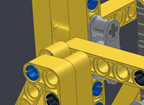
    2. Digital Design – 1:26
    3. Ordering Parts – 3:44
    4. Building – 3:56
    5. Assembly – 5:54
    6. Running – 9:00

    An early testing video.

    Building

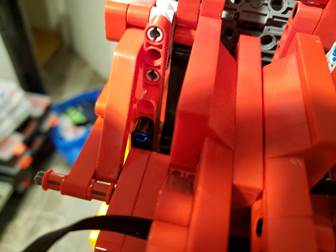
    The Mast and Jib were made up of identical sub-assemblies, making the basic structure quick to assemble.

    Assembly

    • The crane is designed to fold up and fit in a lamp style box, this makes setup and teardown very quick with the tradeoff being space needed for transport and storage.

    Stringing Trolley

    1. Attach string to side of trolley opposite pulling direction
    2. Thread the string around the tensioner and run in through the middle of the jib
    3. Run the cord around the inner pulley on the jib
    4. Wrap the thread around the drum 3 times.
      1. This when tensioned provides enough friction to move the trolley.
    5. Run the string under the jib and attach to opposite side of the trolley.
      1. Ensure the spring is ½ way depressed to provide tension.

    Stringing Hook

    1. Attach the string to the drum gear.
      1. Wind 2-3 turns around the drum
    2. Run the string under the boom and over the trolley pully
    3. Thread through hook.
      1. With the crane assembled, ensure the hook touches the ground
    4. Thread over the other pulley on the trolley
    5. Attach string to side the pin at the end of the jib

    Weaving Catch Net

    Nets are woven together using string to form a cone shape.

    There are 3 rows

    1. 7 nets
    2. 3 nets
    3. 2 nets

    Balancing the Jib

    The jib needs a counter weight of 750grams to balance effectively.

    The counterweight is designed to take Lego train weights but can also be filled with other objects to achieve the required weight.

    Modules

    Pieces Cost Difficulty
    >3000 $$$$ Complex

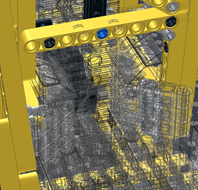
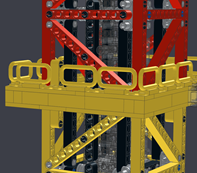
    A render of the completed model.

    Revisions to the digital model

    For this module, I have maintained the digital design and you can read about the changes below.

    • Update design of anti-jam kicker to have more weight
    • Raise the hight of the lift conveyor to give balls more time to drop
    • add more chain guides to stop chain jams at bottom
    • Add a ram to eject balls that return down after triggering the anti-jam kicker.
    • Increase counterweight size to fit 14 train weights
    • Add a blue double pin to the end of every liftarm to brick connection
    • Add missing inner bracing to bottom of mast
    • Remove bracing that was fouling with input
    • Add missing bracing to top of mast
    • Add pins to reduce bowing under load
    • Fix two pins in same hole
    • Fix missing connector
    • Some improvement to order of assembly steps
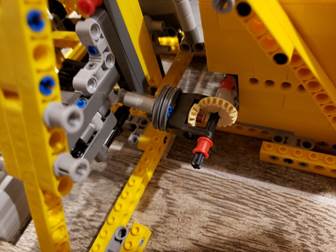
    • Change gear transfer between crane and input bit as knob-wheels were jamming.
    • Add a clutch on the input bin drive
    • Increase the height of the catch arms at the end of the boom
    • Shorten the Jib stay to make the boom flatter
    • Add additional lift arms to reduce load on jib support axle
      Make support axle longer
    • Increase Counter-Jib ballast weight to 750g to flatten the jib
    • Stop flag from rotating
      Note: bar should be swapped for tube if the light is lit up
    • Space IR receiver out more to stop it fouling on motor when jib is folded down
    • Fix pin misalignment indrawing
    • Add ½ pins to stop liftarm from moving
    • Modify Platform to accept downlights
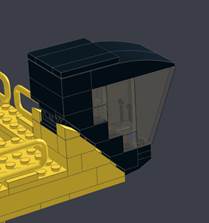
    • Make drivers cab removable for easier packing
    • Remove battery pack as it is inaccessible during shows.Requires cable run down mast instead
    • Change Jib Pivot to stop it fouling on tower platforms
    • Add a positive stop for motor rotation of hook up/down motion
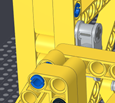
    • Split out ramp for packing
    • Change gearbox design to
      • Support removal for packing
      • Have auto up/down mechanism
      • Be disconnected from input bin
    • Reduce size of tabs on counter weight to make more room for battery
    • Increase bracing on top
    • Additional lift arm bracing in top
    • Remove last guide lift arm as the balls fouled with it when going around the gear
    • New counter jib tie design
    • New jib tie design
    • Updated Kicker to an anti-jam design
    • Updated jib end to improve drop accuracy and stop balls bouncing off the top
    • Add more wheels to trolley to stop jamming while moving
    • Tensioner for trolley in-out rope
    • Update Chain links to have a spacing of 9 between pins and a total of 233 links (9 x 26 = 234 – 1 = 233), this gives a top speed slightly faster than 1 ball per second and will allow the crane to keep ahead of surges.
    • Add initial wedge to guide balls to chain
    • Add more black support liftarms to inner structure
    • Increase strength of bottom support frame
    • Drive gearbox update
    • Update input bin to include agitator
    • Change output ramp design
    • Add feet to tower
    • Add braces to increase tower rigidity
    • Add remote for trolley movement and hook up down (from Sariel’s design)
    • Wheels stop chain from moving and the pins jamming on the tower
    • Ball guide stops balls from falling off pins
    • Change the cab opening so the mini-figure can be replaced

  • Lego GBC Compact Cardan Lift Running

    Lego GBC Compact Cardan Lift Running

    I’ve just published a new video of the Lego GBC Compact Carden Lift module running, you can read more about the modules creation as well as watch unboxing and build videos over at the main post on the Lego GBC Compact Cardan Lift.